Regional Prompt Collapse: Why Strong Brands Disappear From “Best in Region” AI Search Answers

There is a failure mode in AI-generated answers that few brands watch for, mostly because it hides behind good numbers. A company can be well represented across AI systems, named readily, described accurately, spoken about in positive terms, and still be missing at the moment a buyer narrows the question to a region.
Ask a broad question, “Who are the leading manufacturers of custom industrial enclosures?”, and the answer usually holds a sensible spread of players. Ask the same question scoped to a market, “in the European market” or “for buyers in the US”, and the list reshuffles. Locally anchored names move up. Global and foreign-headquartered brands, including strong ones, thin out or drop off.
I call this regional prompt collapse. It is the tendency of AI answers to contract around locally anchored companies as soon as a question gains a geographic scope, pushing out otherwise qualified brands that lack strong regional signals in the sources the model reads.
For B2B marketers this matters more than almost any other AI-visibility issue, for one reason. The regional question is usually the buying question. A procurement lead does not ask who makes good enclosures in the abstract. They ask who can supply them, in their market, under their compliance regime, within their lead times. The scoped question is where the shortlist forms, and it is where the collapse happens.
What regional prompt collapse looks like in AI search results
The pattern is consistent enough to describe plainly. Brands tend to appear in AI answers to broad prompts more often than in answers to region-scoped prompts on the same topic. In one manufacturer audit I reviewed, the brand was named in roughly three-quarters of broad-phrased answers and closer to two-thirds of region-scoped ones. The gap had nothing to do with the company’s actual regional footprint. It had real presence in the markets it was dropped from. The sources the model leaned on simply did not reflect that.
Brand presence in AI answers: broad vs region-scoped prompts
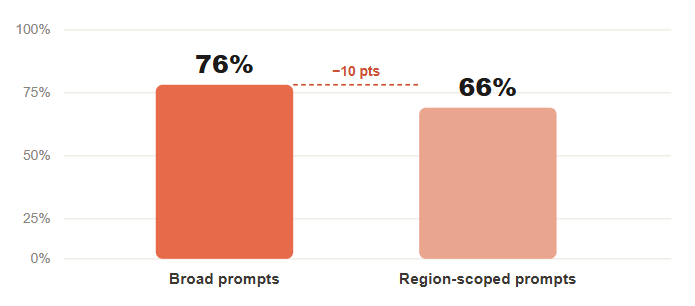
Illustrative, from an anonymized brand audit. The same brand, the same topic — only the prompt’s geographic scope changed.
That distinction carries the whole argument. Regional prompt collapse is not a claim about where a company operates. It is a claim about where a company is legible: where the surrounding web, in the right language and the right regional venues, describes it clearly enough for a model to retrieve and trust it in a local context.
Industry data supports the pattern directly. An analysis of AI-search citations by XFunnel found that when AI engines answered market-specific B2B queries, a large majority of citations defaulted to global .com sources rather than localized ones, and localization rates varied enormously by engine. Because localization is poor, local suppliers get systematically overlooked in favor of US-based alternatives when buyers use AI for vendor research.
Share of localized citations in AI answers, by engine
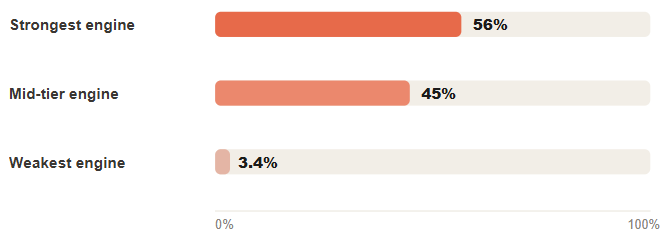
Localized-citation share ranged from over 56% on the strongest engine to under 4% on the weakest. Source: XFunnel AI-search citation analysis, 2025.
Read that through your own brand. The collapse runs in both directions. A US brand can be over-represented in broad answers and still invisible in a German buyer’s localized query. A European or APAC brand can be strong at home and erased the moment a US buyer scopes the question to their market. Either way, geography is rewriting your shortlist without telling you.
Why AI answers drop foreign brands from regional queries
1. The training data is geographically lopsided
Before retrieval enters the picture, the base model carries a geographic prior baked in from its training corpus, and this is well documented. Researchers have shown that large language models make geospatial predictions that correlate strongly with ground truth yet do so unevenly, showing systematic geographical biases in their world knowledge and reasoning. A widely cited study, Large Language Models are Geographically Biased, found these disparities fall hardest on non-Western regions. The root is corpus composition. Common Crawl, the web-scraped dataset behind many major models, skews heavily English: roughly 46 percent of its documents are English-language, and that imbalance contributes to an anglophone bias across a range of tasks. A model that has read the anglophone web far more than any other inherits its center of gravity and its blind spots.
2. Retrieval amplifies the imbalance rather than correcting it
Modern AI answers do not rely on training alone. Google’s AI Overviews, ChatGPT search, Perplexity, and Gemini all retrieve live sources. In principle retrieval should close geographic gaps by pulling in fresh local material. In practice it often widens them. Retrieval ranks candidate sources by relevance to the query, and a region-scoped query rewards sources that are themselves region-anchored: local-language pages, regional trade press, country-specific directories, local case studies. Where those local sources describe some players densely and barely mention others, the answer inherits that density. The research community has flagged this repeatedly: retrieval-based systems can amplify biases present in the retrieved datasets, leading to biased outputs in generation. There is a subtler effect on top. The sources feeding an answer are frequently not the ones you would expect from ordinary search, since AI Overviews often cite pages that are not in the top ten organic results. A brand can rank respectably in regional search and still be absent from the regional AI answer.
3. Weak local anchoring makes a brand easy to drop
When a model builds a regional answer, it favors companies that are anchored to that region in its sources: a local address that recurs, coverage in the local language, regional customer references, market-specific compliance language, presence in the country’s directories and trade publications. A brand that is globally strong but locally thin, described mostly on its own global .com in a single language with few region-specific third-party mentions, gives the model nothing to hold onto when the question narrows. The model does not decide the brand is irrelevant. The brand simply has no handle in that context, and the locally dense competitor does. So the competitor stays and the global brand drops.
Why AI answers drop foreign brands from regional queries
Why regional prompt collapse is a B2B problem in particular
Consumer brands feel this too, but B2B is where it bites hardest, for structural reasons. B2B buying is regional by nature. Compliance frameworks, import rules, service coverage, contract language, lead times, and support hours are all market-specific, so buyers scope their questions by reflex, and they now do that scoping inside AI. Forrester’s research found that 87 percent of B2B buyers consider generative AI in their buying process, using it as a starting point for research and then validating claims through trusted sources. Gartner’s much-quoted projection that traditional search volume will decline about 25 percent by 2026 as queries shift to conversational interfaces means the regional AI answer is becoming the front door rather than a side channel.
B2B buying is also a shortlisting exercise, and that is where the real damage lands. The harm is not that a buyer reads one poor sentence about you. It is that you never enter the consideration set. In a list-based world, being on page two was survivable. In an answer-based world, your page can rank well in the traditional index and still stay unseen if the AI system does not select it for the summary, so citation inside the answer has become the new form of exposure. If the regional answer names three vendors and you are not one of them, you are not losing the deal. You were never in it.
B2B queries are also unusually specific, which sharpens the effect. Engineering-led procurement asks capability and certification questions rather than brand questions, along the lines of an ISO 13485 contract manufacturer with a four-week lead time. Those questions almost always carry a geography, stated or implied. Capability plus certification plus region is the classic B2B prompt, and it is the exact shape most prone to collapse.
What regional prompt collapse is not
Precision here matters, because the wrong diagnosis leads to wasted spend. It is not a ranking problem: you can hold strong regional search rankings and still collapse in the regional AI answer, because the answer is grounded in a retrieval layer that selects sources differently from the classic index. It is not a paid-media problem: regional ad spend does not change how a model represents you in an organic answer. It is not quite a translation problem either. Publishing a word-for-word translated page helps less than expected, because AI-powered search interprets intent and weighs credibility, so localization works when it adapts terminology, examples, and market-specific context, not when it mirrors a page in another language. What it is, is a representation and anchoring problem in the source ecosystem the model reads. That is also where the levers sit.
How to fix AI visibility in regional search: a B2B playbook
You cannot reach into the model. You can shape what it reads. Every step below serves the same goal, giving the model a regional handle it currently lacks.
Audit your brand by region, not only globally
Build region-specific third-party evidence, not only region-specific pages
Make your regional facts explicit and machine-readable
Localize context, not only copy
Track by engine
Localization quality varies sharply across AI engines. The engine where you collapse worst may be the one your buyers in that region prefer, so treat regional AI visibility as engine-specific rather than a single number.
None of this is a quick toggle. Regional anchoring accrues the way trust always has, through consistent, independent, market-native evidence. That is also the reassurance. The collapse has a cause, the cause lives in the source layer, and the source layer is where a brand can do the work.
How to fix AI visibility in regional search: a B2B playbook
Regional prompt collapse stays invisible precisely because the brand looks healthy from the usual vantage point. Broad AI presence is fine. Sentiment is fine. Rankings are fine. Yet at the scoped, high-intent, shortlist-forming moment, the brand is not there.
- The shift underneath it is the part worth keeping.
- In the AI era, entering a buyer’s consideration set is decided less by where you operate and more by where you are legible.
- A model builds a regional answer from regionally anchored evidence.
- Supply that evidence and you are in the room.
- Leave it to your global .com and a translated landing page, and the locally dense competitor takes the seat, not because they are better but because, to the model, they are more clearly there.
- The question is no longer only how visible you are in AI.
- It is how visible you are in AI where your buyers actually decide, and whether the regional web gives the model enough of you to hold onto.
