Should B2B Brands Optimize for Specific AI Engines?
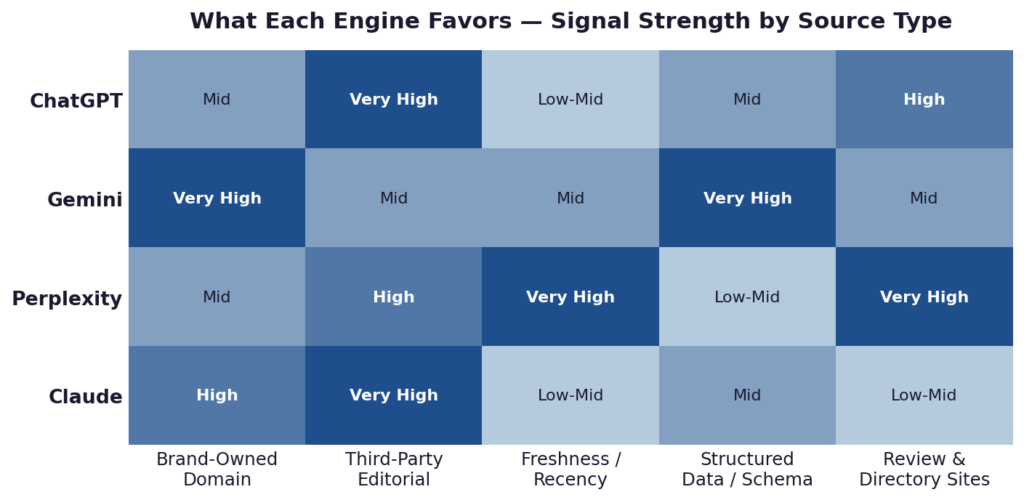
The Data Says It’s the Wrong Question.
|
Key Takeaways
The right metric is AI Share of Voice across all engines, not optimization for a single platform. |
Very often I hear a similar question from marketing leaders:
“Which AI engine should we be optimizing for?”
The fact that so many CMOs are asking it reflects mostly on where B2B brands stand right now:
Aware that something has shifted, but trying to apply old single-channel SEO logic to a fundamentally multi-engine reality.
After running GEO audits across dozens of B2B digital assets and analyzing how each engine handles the same brand query, here’s what the data actually shows.
1. Market Share and Why It Misleads
ChatGPT commands 60-68% of the generative AI chatbot market. Gemini sits at 13-18%, Perplexity at 6%, and
Claude at 3-4%. On raw reach alone, the case for “just optimize for ChatGPT” seems obvious.
But market share is a blunt instrument when the underlying audiences are radically different.

Similarweb’s audience segmentation reveals a clear split:
ChatGPT’s user base overlaps with consumer platforms like YouTube and Instagram.
Perplexity, Claude, and Gemini users gravitate toward professional tools: GitHub, Google Docs, Notion, Figma.
Claude’s 3% consumer share masks the real story: 45% of its API traffic comes from enterprise customers, and it holds 21% of global LLM API usage. For B2B, that’s the number that matters.
Industry-level AI adoption also shapes which engine your buyers actually use:
• IT & Telecom (38% AI adoption) – highest of any sector, skewing toward Claude and Gemini for technical depth.
• Financial Services (24%) and Professional Services (20%) – cautious, preferring sourced answers – Perplexity territory.
• B2B SaaS – AI-referred visitors convert 4.4x higher than organic search when they do arrive via AI.
2. Four Engines, Four Different Systems
When clients say “we want to show up in AI search,” they’re treating four architecturally distinct systems as one.
They aren’t.

ChatGPT, The Citation Accumulator
ChatGPT draws primarily from training data, not live web retrieval. The current model carries a knowledge cutoff
of August 2025 – 79% of responses draw from stored memory, not real-time search.
What wins here? deep historical citation density.
Editorial coverage, analyst reports, industry databases — not a content calendar.
New content takes 6-12 weeks to appear in responses.
ChatGPT’s top cited source is Wikipedia (7.8% of all citations).
Broad, consistent third-party mentions across independent sources is what compounds into a ChatGPT recommendation.
Perplexity, The Recency Engine
Perplexity performs live web retrieval for almost every query, resulting in extreme recency bias.
50% of its citations come from content published in the current year, versus 31% for ChatGPT. Most citations occur within 2-3 days of publication, then decay fast.

Perplexity and ChatGPT share only 11% of cited domains.
Ranking in one gives you almost no visibility in the other.
Perplexity also averages 21.87 citations per response versus ChatGPT’s 7.92 – it’s more generous with sources, but they need to be fresh and industry-specific.

Gemini, The Entity Graph Engine
Gemini is the only major engine built on a search index with decades of entity-relationship data.
52% of Gemini citations come from brand-owned websites, highest of any engine, but trust in your domain is mediated through Google’s entity graph.
Your Knowledge Panel, schema markup, and consistency across Google properties all feed directly into how
Gemini characterizes your brand. Strong SEO rank alone isn’t enough, the entity layer matters more.
Claude, The Conservative Interpreter
Claude handles brand queries differently: where other engines generate answers with varying confidence,
Claude is notably reluctant to characterize brands when signals are thin or contradictory. Weak entity footprints result in omission, not misrepresentation.
Claude’s strongest performance is in knowledge-heavy industries- Healthcare, Higher Education, Industrial IoT.
Its enterprise API dominance means it’s present inside the AI-powered tools your buyers may already be using.
3. The Cross-Platform Visibility Problem
The brand ranked #1 on ChatGPT is rarely the same brand ranked #1 on Gemini. In some industries, the top entity on
one platform doesn’t appear in the top three on another.
A study of 1,200+ AI responses across five B2B industries found significant platform inconsistency in every
sector. And around 80% of URLs cited across the four major engines do not rank in Google’s top 100 for the same query, not because SEO doesn’t matter, but because AI citation logic extends well beyond keyword ranking into
entity authority, source type, and recency.
SEO and AI visibility are correlated – but the strength of that correlation depends entirely on which engine you’re looking at. For Gemini, they are deeply intertwined.
For ChatGPT, the authority signals SEO builds(backlinks, domain trust, entity consistency) matter — but rank alone doesn’t determine citations.
For Perplexity, freshness and directory presence override rank almost entirely.
There is no single answer — which is precisely the problem with single-engine thinking.
4. How Fast Does Each Engine Pick Up New Content?

– Perplexity can begin citing new content within days of publication.
– ChatGPT may take 6-12 weeks. This creates a strategic sequencing question: if you need fast AI visibility.
– ChatGPT is the compounding asset.
5. What B2B Brands Should Actually Do?
Universal signals, all engines respond to these:
• Direct, question-answering content with clear answers in the first 40-60 words of each section
• Statistics and data points every 150-200 words (Princeton GEO research: this improves AI visibility by 30-40%).
• Schema markup and semantic structure
• Accurate presence in industry-relevant directories and review platforms
• Content accessible to AI crawlers (GPTBot, PerplexityBot, ClaudeBot)
Engine-specific layer
ChatGPT: Invest in third-party editorial coverage and analyst
mentions. Build a citation footprint, not a content calendar. Think long-term
compounding, not monthly publishing.
Perplexity: Treat freshness as a ranking signal. Update high-value
pages quarterly. Get listed and stay accurate in your vertical’s key
directories — G2 for SaaS, trade databases for professional services.
Gemini: Audit your Google entity footprint — Knowledge Panel
completeness, schema across your domain, Google Business Profile. If your SEO
is strong but entity signals are thin, Gemini will underperform what your
domain authority would predict.
Claude: Build analytical depth. Long-form, well-sourced content
that covers topics with genuine completeness. Marketing copy is filtered out,
not ranked lower.
The Right Metric: AI Share of Voice
B2B brands asking “which AI engine drives our traffic” are applying last decade’s single-channel model to a multi-engine ecosystem.
The right frame is AI Share of Voice across the full consideration set –
The percentage of category responses that mention your brand, across all engines your buyers might use.
Some are researchers on Perplexity. Some are executives asking Gemini through Google Workspace.
Some are developers querying Claude in their IDE.
Some are decision-makers using ChatGPT to shortlist vendors.
None of them are asking which engine is most popular before they ask their question.
The brands that will own B2B AI visibility over the next three years are building citation infrastructure across all engines – while their competitors debate which single leaderboard to chase..

